Does Your Home Need Rewiring?
Port St. Lucie’s oldest homes were wired decades ago, and some wiring types from that era are worth a hard look today. You may need a full or partial rewire if:
- Aluminum branch wiring. Homes wired between roughly the mid-1960s and mid-1970s often used aluminum for 15- and 20-amp branch circuits. Aluminum expands and contracts more than copper at connections, which can loosen terminations over time — a documented fire-safety concern that many insurers ask about directly.
- Ungrounded circuits. Two-prong outlets mean no equipment ground. Modern electronics, surge protection, and many appliances expect a ground path.
- Brittle or damaged insulation. Old cloth- or rubber-insulated conductors become brittle, crack, and expose copper inside walls, attics, and crawl spaces.
- Frequent breaker trips or warm outlets. Chronic overloading and heat at devices can signal wiring that’s undersized or deteriorating.
- Two-prong outlets and no GFCI. Older bathrooms and kitchens wired without grounded, GFCI-protected receptacles are due for modernization.
Not every old home needs a full rewire. We inspect first and tell you whether a targeted partial rewire — one or two problem circuits — will do the job, or whether the whole home warrants new wiring.
Aluminum Wiring: Your Options
Aluminum wiring deserves its own conversation because it’s common in this region’s mid-century homes and poorly understood. There are two legitimate paths:
Which one fits your home depends on the wiring’s condition, access, and what your insurer requires — we’ll lay out both options with an inspection report.
What the Multi-Day Process Looks Like
A whole-house rewire is a project, not a service call. Here’s how we run it:
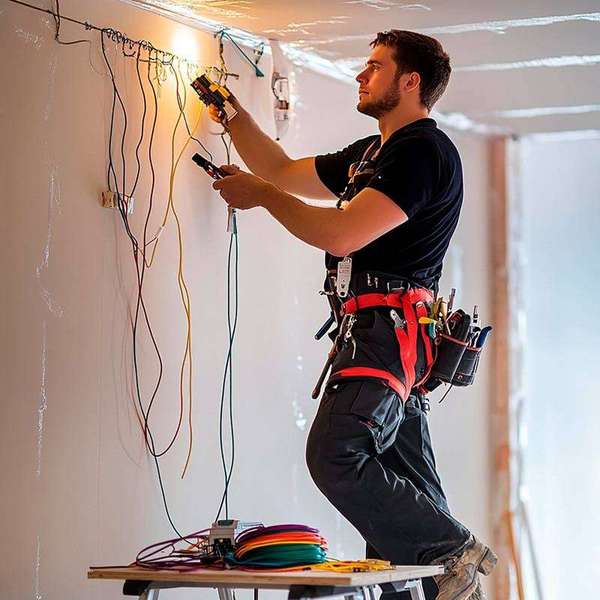
- Walkthrough and plan. We map every circuit, inspect the panel and accessible wiring, and plan the new layout — where each run goes, what gets upgraded (grounding, GFCI, arc-fault protection), and the room-by-room sequence.
- Permits pulled. Rewiring is permitted work; we handle the application and schedule inspections at the required stages.
- New wiring, zone by zone. We run new cable room by room, cutting the minimum access needed in walls and ceilings. Most runs go through attics, crawl spaces, and closets to keep finished walls intact.
- Devices and panel work. New receptacles, switches, and cover plates; the panel is re-terminated, labeled, and brought up to the required protection standards.
- Inspection and power-over. The work is inspected, circuits are energized and tested under load, and old wiring is abandoned in place or removed where accessible.
Living Through a Rewire
The question every homeowner asks: do we have to move out? Usually not. We keep working zones powered wherever possible — rewiring one part of the house while you live in another, with power restored to finished zones each evening. Expect some dust, some access holes (patched and ready for paint), and a few days to a couple of weeks depending on the home’s size and access. We tell you the real schedule before we start, and we keep to it.
Older Homes Across the Treasure Coast
We rewire homes throughout the area — the mid-century neighborhoods of Port St. Lucie and Fort Pierce where aluminum wiring is most common, and the established communities of Stuart, Jensen Beach, and Palm City where original wiring is simply reaching the end of its service life.
- Port St. Lucie
- Fort Pierce
- Stuart
- Jensen Beach
- Palm City
Request a Rewiring Estimate
Tell us about your home — its age, what you’re seeing, and whether you know the wiring type — and we’ll schedule an evaluation.
House Rewiring FAQs
How long does a whole-house rewire take?
It depends on the home’s size, number of circuits, and access (attics and crawl spaces speed things up). A typical single-family home takes several days to a couple of weeks. We give you a written schedule after the walkthrough.
Can I stay in the house during the rewire?
Usually yes. We work zone by zone, keeping finished areas powered and restoring power to completed zones each day. You’ll have dust and some noise during work hours, but not a move-out.
Will you have to tear open my walls?
We cut only the access needed, and most runs go through attics, crawl spaces, closets, and behind baseboards to minimize openings. Access holes are patched and left ready for paint.
Is aluminum wiring actually dangerous?
Aluminum branch-circuit wiring is a documented concern because its connections can loosen over time, creating heat. Many insurers ask about it for that reason. The good news: it can be properly remediated at connections or fully replaced — both are established, code-recognized approaches.
What’s the difference between a full rewire and a partial rewire?
A full rewire replaces all branch-circuit wiring in the home. A partial rewire targets specific problem circuits — say, the aluminum runs or the ungrounded bedroom circuits — while leaving sound wiring in place. We recommend only what your home needs.
Do you replace the panel as part of a rewire?
If the panel is in good condition, it stays — we re-terminate the new circuits into it. If the panel is also aging or damaged, we’ll recommend replacing it as part of the project and price it together.
Does rewiring require permits and inspections?
Yes. Rewiring is permitted work, and inspections happen at required stages. We handle the permits and coordinate every inspection.
Will my homeowner’s insurance be affected?
Insurers in Florida commonly ask about wiring type, especially aluminum wiring and fuse boxes. A permitted rewire with inspection records is exactly the documentation insurers want to see. (We’re electricians, not insurance agents — confirm specifics with your carrier.)